Loading

 |
WHAT'S NEW
|
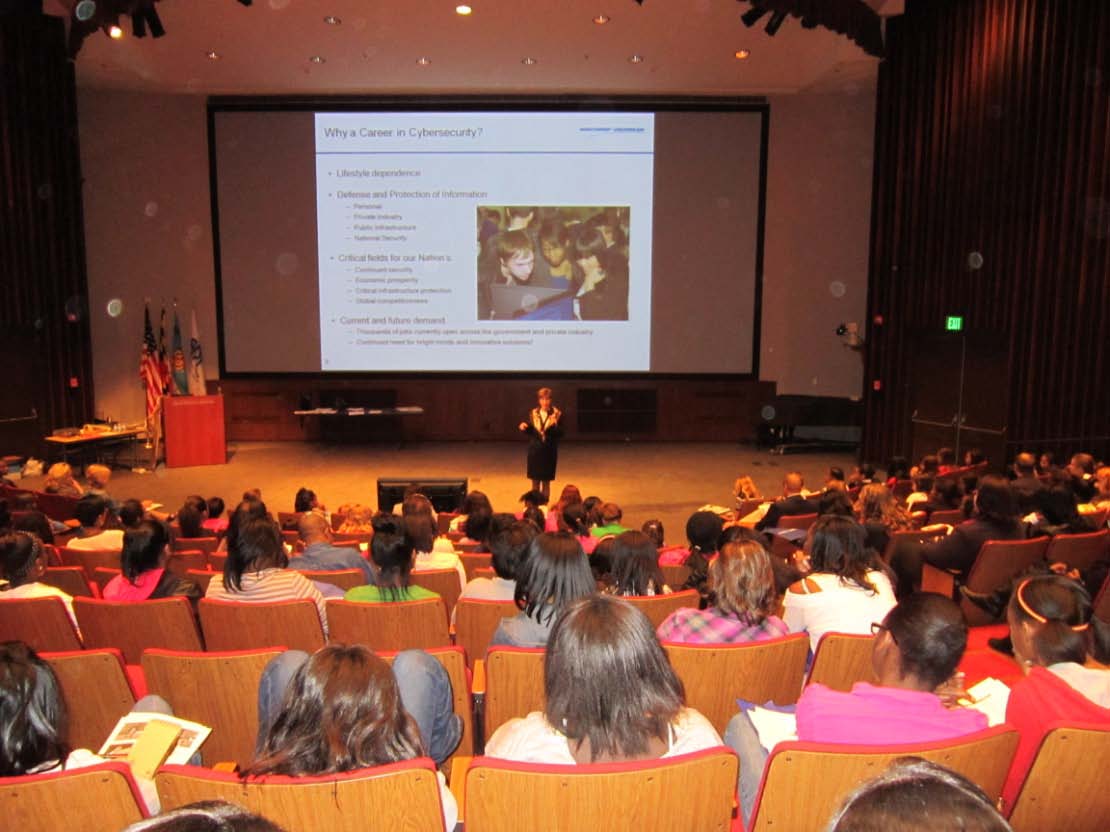
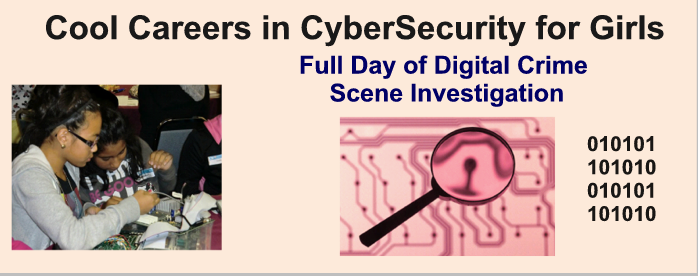
Cool Careers in CyberSecurity for Girls WorkshopOverview A series of workshops provide students with the information and skills necessary to navigate the professional pipeline in the vast fields of CyberSecurity and Information Assurance, as well as, other science, technology, engineering, and mathematics (STEM) fields. The Annual Careers in CyberSecurity for Girls Workshop , presents a cyber crime scenario, and the elite all girl CSI teams use a variety of clues to solve it, while also learning about the plethora of career options in CyberSecurity from women in business and government throughout the state. Despite the gains of the last twenty years in the representation of women in STEM fields, their numbers still lag behind their male counterparts. Researchers have found that until third grade an equal number of boys and girls show interest and feel confident in learning science and technology. However, these numbers continuously decrease for girls throughout middle school and into high school. Various explanations for the significant decrease in girls’ interest in science and technology through their school years have been posed. Cool Careers in CyberSecurity Workshops sponsored by CyberWatch draws on research that that indicates recruiting and retaining girls to the science and technology fields should include targeted programs to educate women and minorities about STEM career choices. Many women and minorities have had limited exposure to computing in grade school and high school, especially if they come from lower-income households and communities. A new National Research Council report indicates that general Information and Technology Fluency skills and concepts will also be needed by all citizens if they are to be competitive in the modern world. Curricula should provide early exposure to real-world examples of the content of interest connected to careers. Enrichment programs should emphasize team projects and diverse real-world examples of technology applied in content areas. Curricular material that addresses major societal and/or environmental problems has been shown to attract women to the discipline. Mentoring and role models in the career choices has also shown success in recruitment and retention. HistoryThe first workshops, titled Cool Careers with Technology, were held starting in 2001 in partnership with the University of Maryland and Prince George's County Parks and Recreation. They served as an extension to the Young Scholars Program held during the summer; encouraging students to pursue STEM courses in high school and careers in fields that use technology. The first in a series of Cool Careers in CyberSecurity Workshops was held at the University of Maryland on Friday April 21, 2006. The workshop provided participants with a full day of speakers, hands-on activities and campus site visits. 30 middle school girls had the opportunity to learn from women from companies and agencies throughout the state about what it takes to be a true success in the field. Attention was given to issues for women from underrepresented groups. The CyberWatch K12 Division continues to offer small workshops for individual schools/school districts, but has also expanded to offer an Annual Cool Careers in CyberSecurity Workshop for Girls Workshop. At the Workshop, a Cyber Crime Scenario is presented to the girls. The attendees are broken up in to small CSI teams of 10 and rotate around different “cyber tables” to gather clues to solve the cyber crime. Each table has a different activity led by a women professional in the field. The girls use the first part of each rotation to gather a clue, and the remainder of the time is used to learn more about the career and how each representative entered the field. Girls find out more about the education skills needed, likes and dislikes and salary range. Activities have included: cryptography, assembling a computer, steganography, penetration testing and cell phone forensics. 2015 Cool Careers - Steubenville, Ohio
2014 Cool Careers - Southern Maryland The National CyberWatch Center in partnership with the Maryland Department of Business and Economic Development and College of Southern Maryland
2014 Cool Careers - UMD - Central MarylandThe National CyberWatch Center in partnership with the Maryland CyberSecurity Center
2014 Cool Careers - Western MarylandThe National CyberWatch Center in partnership with the Maryland Department of Business and Economic Development and Hagerstown Community College 2013 Cool Careers
2012 Cool Careers In CyberSecurity Workshop
2011 Cool Careers In CyberSecurity Workshop
2010 Cool Careers In CyberSecurity Workshop
Other Workshops
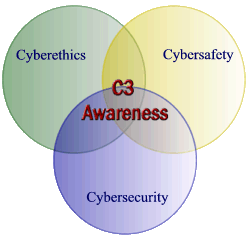
Workshop 1 HighlightsThe opening speaker for the Cool Careers in CyberSecurity for Girls Workshop will be Vonda Williams, CISM, CABM, Director, Information Assurance, Solvern Innovations, who applies cutting edge technology solutions and simulations provide objective solutions to critical problems of importance to national security. Her presentation is Cool Careers! Information Assurance [PPT ... PDF] and All Aboard the Cool Security Express [PPT ... PDF]. Joan Upole, Executive Officer for a subcommitte of SIGCOM at NSA, will then discuss Ethics and Computing which will discuss a variety of both legal and ethical issues one must consider when participating online. Ms. Upole will discuss these issues in the context of what you want to do, what you think you should do, and what you can be prosecuted for doing. She will also discuss some of the ways your persona is identified online and how that information can be exploited. After lunch students will visit Trufina, a small start up company located in the Technology Advancement Incubator Program on campus that provides a web based application to assure a safer, secure and trustworthy way to identify yourself to others and for others to truthfully identify themselves to you. The girls will then tour the GIS lab in the Department of Geography to visit a number of researchers and current research projects. Girls are recruited through the campus Talent Search Program. Funded by the U.S. Department of Education, Talent Search is designed to provide students with early college awareness and post secondary opportunities to all students the our program. This is done through a variety of activities and workshops that encourage students to pursue an academically rigorous course selection. Students participate in a wide variety of college tours, and leadership activities to strengthen their motivation and persistence in school, as well as engage in leisure services so that they can become well-rounded students. The program targets youth in families in which neither parent graduated from college. Female middle school members of the Educational Talent Search are individuals who have maintained a 3.3 or above, have held a consistent "B" average in math and science, and have good citizenship as described by their teachers and counselors. Students stay with their middle school "UMCP counselor" for 2 years and then move to a "UMCP high school counselor" for their high school career. Workshop 2 HighlightsUniversity of Maryland hosted the second in a series of Cool Careers in CyberSecurity Workshops which provided information and skills necessary to navigate the professional pipeline in the vast fields of CyberSecurity and Information Assurance as well as other science, technology, engineering, and mathematics (STEM) fields. The second workshop was held Friday October 6, 2006.The workshop was run in conjunction with the 5th annual Cyberethics, Cybersafety and CyberSecurity (C3) conference. 30 middle school girls and 20 high school students (N: F=11; M=9) participated in a full day session which included hands-on activities, speakers, and an opportunity to talk with professionals in the field. Students had the opportunity to learn more about Cyberethics, security and safety, as well as, learning first hand from IT/IA experts about career opportunities and pathways in CyberSecurity . Attention was given to issues for women from underrepresented groups. The participants heard from the opening speaker Maryland’s First Lady Kendel S. Ehrlich whose initiatives include working with the iKeepsafe coalition to keep kids safe online and helping promote initiatives highlighting career opportunities in CyberSecurity and other IT fields.. Detective Sergeant Robert Smolek from the Maryland Internet Crimes Against Children Taskforce then discussed computer facilitated crimes against children, with a particular focus on victims, offenders, and those online technologies commonly used to sexually exploit children. Detective Smolek discussed and showed how tools such as digital forensics can help catch criminals. Naomi Lefkovitz from the Division of Privacy and Identity Protection of the Federal Trade Commission presented Deter, Detect, Defend: The FTC's Program on Identity Theft [PPT]. Information Security in Today's World [PPT] Casey O'Brien an Associate Professor and Network Technology Program Coordinator from the Community College of Baltimore County (CCBC) and consortium member, provided students with an overview of: what information security is; the challenges to information security; the latest trends; best practices to help protect your digital assets; the need for Information Security professionals; and CyberWatch. A luncheon allowed students the time to network with IT/IA professionals. The Keynote LuncheonIntroduction was presented by Liesyl Franz , Department of Homeland Security introducing Keynote presenter Ron Teixeira Executive Director and Alyssa Marlow, Manager of Programs and Communications of the National Cyber Security Alliance who discussed the importance of cybersecurity, and how the education of our youth and public about IT/IA career opportunities is imperative to the future of industry. Students then participated in an interactive, hands-on session with Craig Holcomb from the National Security Agency . Mr. Holcomb first presented on the Ethical Use of Computers and then using cryptology-the study of code, and cryptanalysis (breaking secret codes), students encrypted and decode messages enabling them apply cryptographic methods and understand how these methods can be used to enhance security.
|
In This Section |
|